Showing posts with label Richard Murphy. Show all posts

Sunday, 16 June 2013

Damned

Pat comments, over at Tim Worstall:
.. the Government is very much to blame for surrendering to the Left’s ghastly narrative at the first possible opportunity. Without a good political counterbalance this tax nonsense will continue to run further from common sense. One just hopes the general ineffectiveness of Government will prevent any real damage.
.. whilst Ben Saunders delivers a professional's analysis of the Fair Tax Mark:
Rather than making me want more tax disclosure, it makes me feel like we should have less. It appears that tax campaigners are unable to understand the tax disclosure notes already published. I have very little confidence in them understanding even more data.
Let's address Pat's notion that the government should be providing 'counterbalance' to the increasingly extreme reaches of the current 'tax justice' movement. That comment, I should point out, is in response to outrage about what a (full) tax-paying company has done with some of it's post-tax income.

The problem for the government, and for Pat, is that there is nothing at all to be gained for the politicians by criticising the fair tax movement. That war was lost as soon as the public mood was captured. We saw, with the banking crisis, that people want (maybe even need) a bogeyman. Ideally, a rich one. Corporations are perfect. They are largely faceless, and their alleged misdeeds will, inevitably, involve big numbers. Indeed, the bigger the better.. hence we hear a lot about the billions they generate in revenues, even though profits (pre or post tax shenanigans) may be small or non-existent.

If the politicians come out in support of the companies then they are siding with 'big business'. And so the debate ends. Nothing they say about jobs and investment and services will counter the simple 'I have to pay all my tax, so should they' retort. Cameron's 'we're all in this together' soundbite is, well, biting him on the arse. But even if he'd not said it, the situation would be the same.

The government has two options. They can cede to the campaigners and see what happens.. knowing that if the results are bad for the country it will be their fault, but if they are good then the credit will go to everyone but them. OR, they can say the right things to the camera, whilst (and this is regrettable) carry on, privately, doing what they believe is right. Richard Murphy will continue to shout that the actions are not in accordance with the words, but such is is politics there's no avoiding that. If, in the background, the government and the market can bring about a steady movement away from the more egregious end of the avoidance spectrum then the mainstream media will lose interest and no harm will be done.

So what about the 'Fair Tax' mark? Well, it's another example of what the politicians are up against. How do we think it plays if they criticise it? It's a devious corruption of a notionally good idea. Perhaps the government should have seen it coming and, with the fanfare they command, got there first with something a little more fit for purpose? But it's really not their place to provide a kite mark over and above compliance with the laws that they have made. Margaret Hodge can grandstand about fairness and morality from the safe position of someone with no power or remit to enact laws that would enforce it. Cameron and Osborne won't have that luxury until after the next election.

What we need for the Fair Tax mark is, insofar as is possible, is the silent treatment. We need no acknowledgement from government, and (perhaps more importantly) none from the companies that it targets. Even those who manage to score highly. The overton window has shifted far enough towards the worldview of a few statist extremists and political opportunists.

Richard Murphy believes that provision of full employment is a core requirement of the state. His list of things that the government shouldn't provide to the proletariat is limited, and he's still not keen on anyone making much profit thereon. So it's fair to conclude that he's, at best, ambivalent to the private sector as a whole. On that basis, I'd caution against *any* private enterprise engaging with any of his whims. Even if Amazon and Starbucks are your enemy, he is not your friend.

Friday, 11 May 2012

On Murphy

I feel moved to write about something that Richie 'Richard' Murphy has put out there. Picking on Murphy is a happy pastime for a lot of people, and whilst Murphy does himself few favours (on a variety of fronts) I sometimes find it all a bit much. He is doing something which, I think, needs to be done... educating the wider world about who might not be paying as much into the pot as we might like. Unfortunately, his political and moral compass is very firmly in a certain camp, and there is rarely any balance in a great deal of what he writes.. which is increasingly overshadowing the genuine issues that he could be dealing with. I should add that whether or not [insert tax avoider of choice] should pay more tax is, ultimately, for the people to decide. I am happy for Richard Murphy to explain why he thinks Barclays should pay more tax, and then for the population to decide whether or not they give enough of a fuck to bank elsewhere.

But, returning to Richard Murphy, unless someone turns up to do his job better than he does it, he's all there is.. and constantly poking him with a stick is achieving nothing. He's not going to change and, indeed, his 'popularity' is increasing and, he very much enjoys the sniping which simply reinforces his view that nothing worthwhile comes from those who would challenge him.

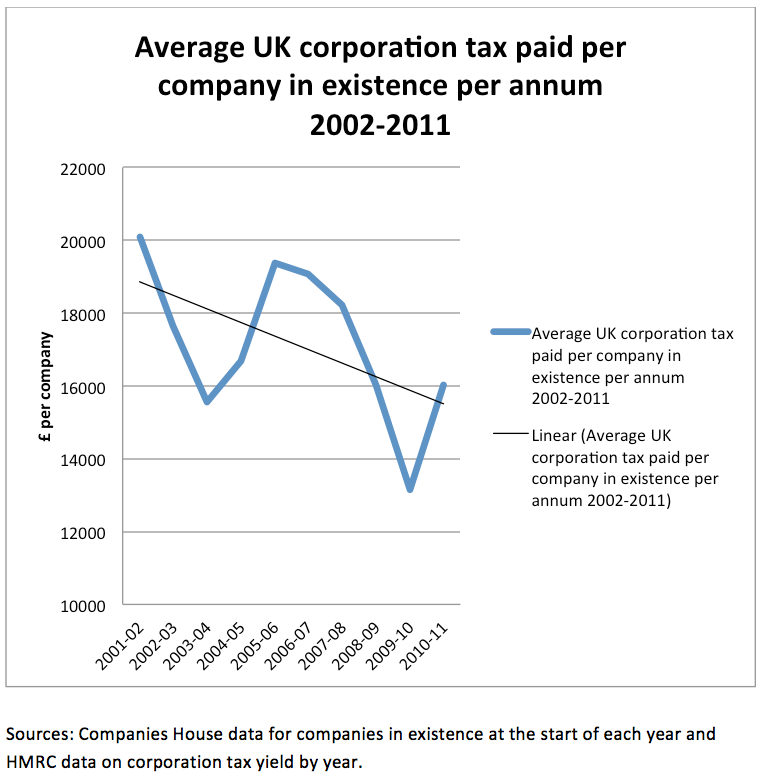
Today he asks us 'Why are companies paying less tax?', and shows us a graph which clearly illustrates that companies are, indeed, paying less tax..


Richard clearly explains what he has done.. he has taken the number of companies in the UK in each year, and the total corporation tax paid, and he's calculated the average paid per company. He's then drawn a line to show the trend.

Or, as the always well-informed Frances Coppola points out in the comments over in Timmyland..
He achieves this remarkable effect by drawing a straight line through two recessions (the second considerably deeper than the first) separated by a boom and followed by the current stagnation.
In the comments on his post, Richard explains that there was a large rise in company numbers in 2004, and as he wanted to show a 'before/after' picture he started his line before that (as one of his commentators points out that starting the line in 2003/4 would have it trending upwards). I'm not quite sure why 2001/02 thus becomes the starting point. But let us not get too carried away over this sideshow..

Murhpy, eagerly pre-empting anyone who might wish to trouble him with a critical comment, quickly draws attention to an issue (my emphasis)..
It’s immediately possible to say that of course the amount of tax per company has gone down because the number of companies has gone up, but then so has to proportion of profits in GDP, so that doesn’t quite stack, but I agree I need to do more on that issue.
Well, yes. You do. We have an increase of over 1 million companies during the period... or 62%. GDP rose by 42% over the same period, and we have an understanding that there was a spike in incorporations in 2004 due to a (subsequently withdrawn) tax 'fiasco'. That is a huge increase in company numbers, and to assume that the tax profile of those million companies which were added to the register during this period is comparable to that of the 1.6million companies on there at the start, which is what Murphy has done, is farcical... not because it's necessarily untrue (a cursory analysis of table T11.3 in HMRC's corporation tax statistics indicates that the percentage of corporate profits charged at the main and small company rates has not varied a great deal between 2002 and 2010) but because it's wildly premature.

Murphy is eager to point out that 'small companies do pay tax', and he's right... but they pay it at a materially lower rate. He charts a fall in average tax paid (either end of his trend line) from £19,000 to £15,800.. about 17%. The small company tax rate is 25% lower than the main company rate, so a shift in the profile will lower the average rate.

I decided to redraw the graph but adjusted to try and take out two distorting factors..

  1. A disproportionate growth in the number of companies (measured relative to GDP)
  2. The fall in the main company tax rate from 30% to 28%
The first is because I'm saying that if we're going to run with Murphy's assumption that the new companies are comparable with the old, we at least need to take out those which added nothing to GDP (coincidentally, perhaps, this leads me to effectively eliminate the effects of the 2004 spike). The second is because we don't need to look for sinister reasons why average tax might have fallen in the last couple of years (and Murphy does go on to speculate on the sinister).


So here's my graph and trendline (the red ones) on top of RM's (the blue ones). I've got the *real* average tax rising. So everything is fine and Richard Murphy is an idiot, yes?

Well, no.. because Richard has shown that you can prove anything by doing a little bit of research, making wild assumptions, and cherry picking what you present. I have proven that you can take data that has been abused to make one point and throw in a couple of plausible sounding assumptions which
make the data say the opposite. And I could easily go further. And I could easily convince anyone pre-disposed to my desired conclusion and lacking the ability/will to question it, that Murphy has no idea what he is talking about and should be forever ignored.

Murphy goes on to discuss his issue with the failure of 700,000 companies a year to submit their corporation tax return. He thinks that this covering up a significant amount of evasion, and that this is a key element of his much-quoted £120bn tax gap(1). I think that anyone who registers a company should comply with HMRC requests for information. If you wish to incorporate, and avail yourself of the legal protections is affords, then it's not a big ask. I think Murphy grossly overestimates the quantum of the tax loss, but that's something of an irrelevance because I agree that something should be done to deal with the problem. It is not acceptable that 30% of companies don't fulfil the modest obligations that parliament has imposed upon them.

And, so, therein lies my big problem.. he's got a point to make, and it's a point I'm happy to see made.. but I don't want to see it made with the aid of such a clumsy tool (I mean the graph, not Richard Murphy), because Murphy's audience will just take the tool and present it as further 'proof' that Phillip Green is the cause of all of our ills. Murphy knows this, he (I am sure) believes that having these misconceptions continually shouted from the rooftops (literally, on occasion) is a good thing, because the benefit of the PR outweighs the harm of an ill-informed populace looking for hate-targets.

I, respectfully, disagree.


(1) As an aside, but which fits with where I find my greatest frustration, Murphy has never suggested that this is something done by large companies and rich individuals.. because he knows that if there is a problem here, then it's the little guys. It's tax evasion, and people who can afford to minimise their tax legally will usually avoid minimising it illegally. However, his £120bn figure is usually attributed by others (UK Uncut, Union leaders etc etc) almost solely to big business and the 1%. I've never seen Murphy attempt to correct this obvious misreading of his own research, which bothers me because if he really wanted tax justice he would want a better understanding of the fact that evasion and avoidance is something which, whatever the quantum, pervades society. If Mark Serwotka, who made this error on Question Time last week really wants that whole £120bn collected, then he needs to be willing to tell the 99% that we, too, need to stump up our share.